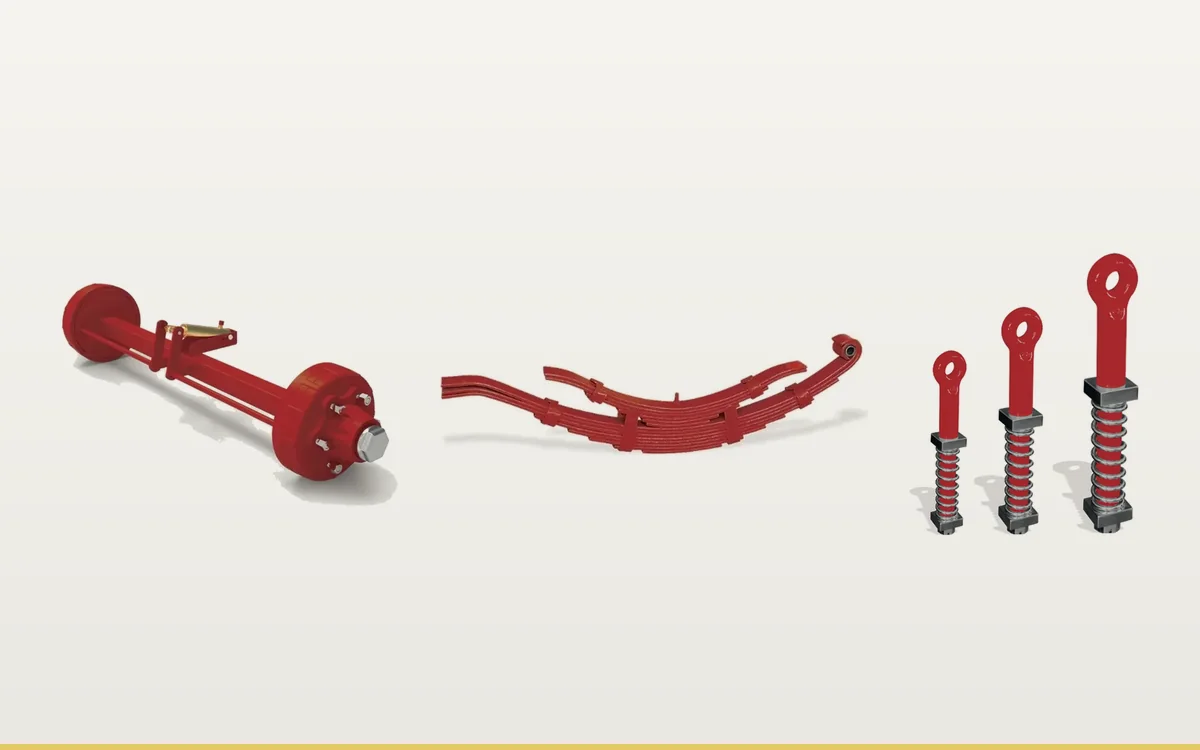
No single part decides how much a trailer can carry. However well the body is built, its capacity is set by the weakest of the axle, hubs, leaf springs, tyres and rims. This article explains how to read the capacity of each of these parts and how to match them, with a worked example at the end.
The calculation starts with the total weight of the trailer when loaded: its own weight plus the heaviest load it will carry. Grain, sand, fertiliser and bales weigh very different amounts per cubic metre; the same body filled with sand is much heavier than when filled with grain. So the question to answer is not "how many cubic metres does the body hold" but "how much does the trailer weigh when the body is full of my heaviest load".
If you do not know the empty weight, the most reliable way is to weigh the trailer on a weighbridge. Grain buying points, cooperatives and municipalities often have one. Weigh it once more on the same bridge with your heaviest load and the first step of the calculation is done.
On two-axle farm trailers with a turntable at the front, the load is shared roughly equally between the two axles. On single-axle trailers part of the load passes through the drawbar to the towing vehicle and the rest sits on the axle. The share that goes to the vehicle also decides the drawbar eye and jack you need.
The load is not always spread evenly in the body. Weight piled at the front or back puts more on one axle than the other. When a trailer drops into a hollow in a field or runs over a bad road, the momentary load on the axles rises above the static figure. So base the calculation on the worst case, not the average, and choose parts with some margin rather than right at the limit.
Axle capacity is the load the axle can carry across both wheels. Our 10/12 braked axle, for example, is rated at 6,500 kg and the 11/13 braked axle at 8,000 kg. Hub capacity is given per hub: 3,300 kg for the 10/12 assembled hub, so 6,600 kg for the two ends of one axle. Axle and hub capacities should be close to each other. Fitting a weaker hub to a strong axle effectively brings the axle down to the hub's rating.
Spindle diameter is part of this match. A hub is made for a given spindle diameter: 65 mm for the 10/12 hub, 70 mm for the 11/13 hub. A hub with a different spindle size simply will not fit, but several capacities can share one spindle size, so check the catalog when choosing.
Leaf spring capacity is also given per spring, and each axle has one spring at each end. A spring is defined by its number of leaves, leaf section and length. A 14-leaf spring with a 63/8 section and a length of 1,100 mm, for example, is rated at 4,500 kg. More leaves make a stiffer spring. A spring that is too stiff for the load is one reason an empty trailer rides hard and bounces.
If the trailer often runs empty and sometimes fully loaded, a helper spring is a sensible choice. It has shorter helper leaves under the main leaves. When the trailer is empty only the main leaves work; as the load increases the helper leaves come into play. The empty trailer rides softer and the loaded one still gets the stiffness it needs.
The load a tyre can carry is shown by the load index on its sidewall. The load index is a code, not a weight in kilograms. An index of 140 means 2,500 kg per tyre, 142 means 2,650 kg and 150 means 3,350 kg. These values apply at the inflation pressure given by the tyre maker. An under-inflated tyre cannot carry that load; it overheats and the sidewall is damaged. Check the pressure when the tyre is cold, before setting off; pressure rises as the tyre warms up on the road and reads higher than it really is.
The PR (ply rating) often seen on agricultural tyres says something about carcass strength, but on its own it does not give a capacity in kilograms. Two tyres of the same size and PR can have different load indexes, so always check the load index and the recommended pressure.
The rim is part of the capacity too and has its own limit. Its stud pattern must also match the hub: a 5-stud rim cannot be fitted to a hub with six 3/4" studs. The centre bore and the stud pitch circle must suit the hub as well; these dimensions are listed separately in the technical table of our hubs.
Take a two-axle farm trailer with a front turntable. Empty weight is 2,500 kg and the heaviest load it will carry is 8,000 kg. Loaded, the trailer weighs 10,500 kg, or 5,250 kg per axle if shared equally.
A 9/11 axle rated at 5,500 kg looks sufficient on paper, but once you allow for uneven loading and the extra momentary load in the field, it is at the limit. A 10/12 axle rated at 6,500 kg is the better choice here, with 10/12 hubs rated at 3,300 kg at each end.
The load per wheel is half of 5,250 kg, about 2,625 kg. A tyre with load index 140 (2,500 kg) is not enough. You need at least index 142 (2,650 kg), and an index above that is better for margin. On the spring side there are two springs per axle, so again about 2,625 kg per spring. A spring rated between 3,500 and 4,500 kg suits this trailer; if it often runs empty, a helper spring in this range will give a more comfortable ride.
Brakes matter more as weight goes up. Trailers whose loaded weight is more than a few tonnes need braked axles with drums; unbraked axles are for light trailers. When you choose a braked axle, note the drum and lining size as well. The 300x60 lining, for example, is shared by many of our drums from 8/10 to 11/13, which makes it easier to find spare linings years later.
On single-axle trailers, the load that passes through the drawbar to the vehicle decides the drawbar eye and jack. Drawbar eye capacity depends on thickness and length; our 65 mm thick, 500 mm long sprung drawbar eye is rated at 12,000 kg. The jack carries the front of the trailer once it is uncoupled, so its capacity should be above that load.
Once you have done these sums you will have a load figure per axle, per wheel and per spring. Choose the parts to these figures so that no clear weak link is left between them. The capacities of our products are listed on the product pages and in our catalog. Send us your trailer's empty weight and the load it will carry, and we can make the choice together.
 TR
TR
 EN
EN
 RU
RU